Reflective Dog Leadership — What’s Your Leadership Model Called?
Do what Nature insists must be done, and don’t do what Nature insists should never be done: do the dos, and don’t do the don’ts:
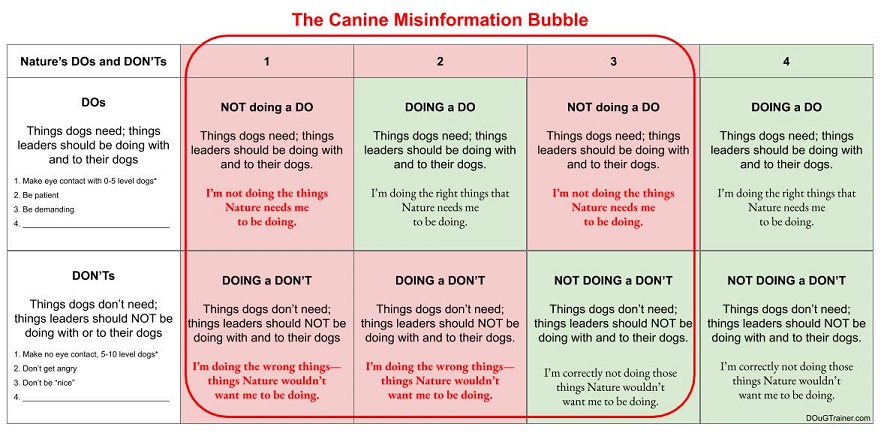
Too many owners unknowingly operate from inside their own misinformation bubble.
Calm, human patience directed toward 0-5 level, relaxed dogs triggers Nature’s triggers to be calm and submissive. The dogs have no control of it—it’s a reflex. It’s built into their DNA. They never know what hit them, and Nature intended it to be that way. When dogs are relaxed and voluntarily submissive over long periods of time—their natural state they were born into—that sustained, relaxed state results in their becoming balanced, that is, a balanced state is one in which
- the dog’s range of typical calm-energy or calm-excitement levels are consistently low (on an informal, 0-10 scale, they’re at a 0-5 range, instead of 5-8 or 5-10 range)[1]
- the dog sleeps a lot,
- the dog doesn’t bark excessively,
- the dog listens more to its leader and it listens better to its leader; it ignores its leader less,
- the dog pays more attention to its leader than to its environment and the sounds in its environment,
- the dog isn’t threatened by being triggered to be calm[2]
- the dog will yawn a lot, with its jaw relaxed and slightly open, sporting light, relaxed, “heh, heh, heh” style, open-mouth breathing.
Patience is the rule. Patience—on the human’s part—is always the rule.
The leadership model I use I call Reflective Dog Leadership. What’s the name of the model you’re using called? If your model for dog leadership doesn’t have a name, what does that say about the model you’re using?
Name your model, then start comparing them: the numbers every model will create will tell us what works and what doesn’t work.

[1]The overall calm-energy continuum:
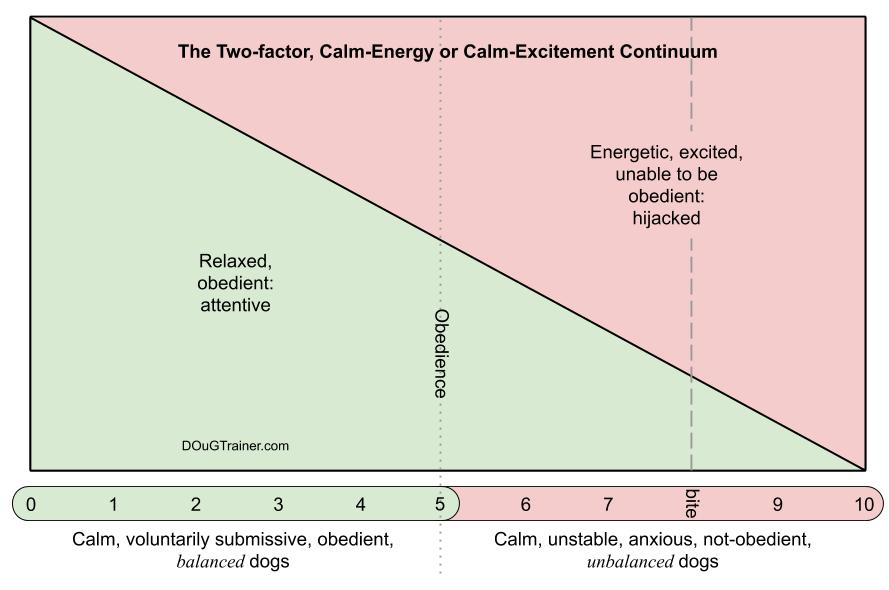
the high energy, stressed, unstable range:
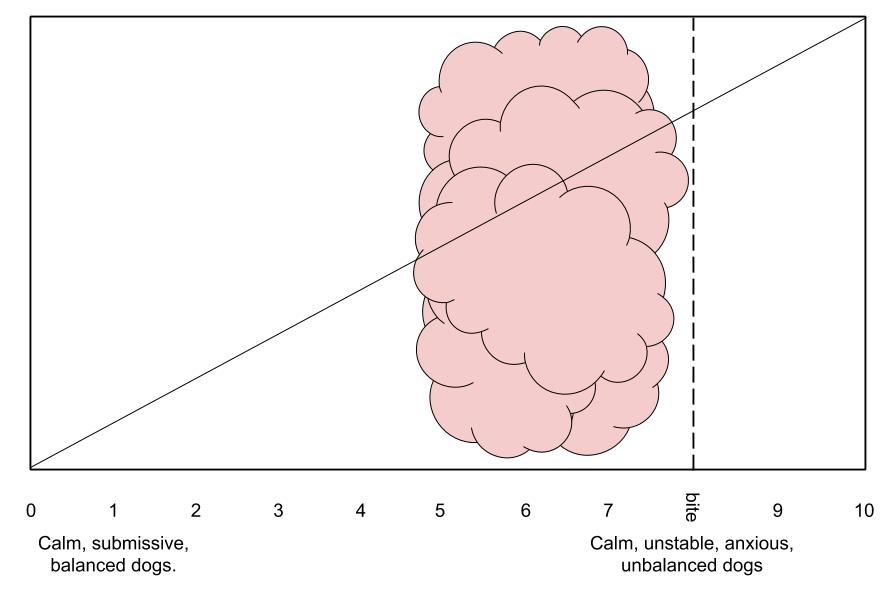
and the calm, balanced range:
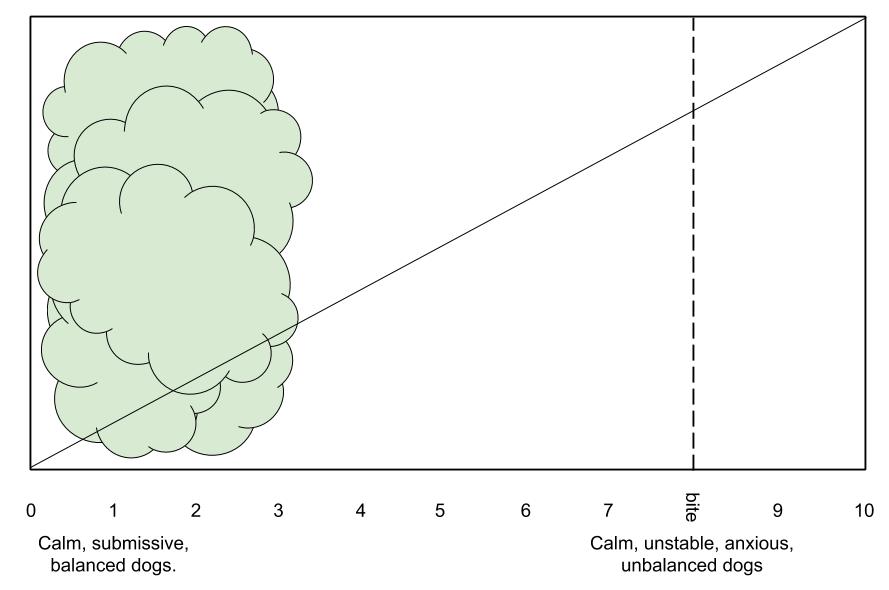
[2]Sometimes misidentified, incorrectly identified, and which has historically been mislabeled “territorial aggression,” an unstable and aggressive dog being triggered by me to be calm and submissive (to be on the receiving end of Nature’s triggers it can’t control) detects and gets threatened by Nature’s triggers I trigger in the unstable, unbalanced dog.
Since those triggers trigger internal sensations within the dog, since the dog isn’t mentally sophisticated enough to know that the trigger is coming from his internal space, it detects it, it puts those sensations onto its eye’s projector, projects that source of that perceived threat onto the only animal-thing around it—which happens to be its trainer, me—and mounts an aggressive attack to make the unwanted thing(ironically the better thing, which it hasn’t experienced for a long, long time, and which its absence has resulted in the dog’s ultimate unstability) to make the trigger’s sensations go away.
Actor Jim Carrey says “The eyes can be a screen as well as a projector.”
Working with Nature—Assumptions on Nature’s Basics
Here are some common sense assumptions related to Nature that anyone can make. Then, once having made those assumptions, they then have to fit into the training that’s being done. Here are some of those assumptions of Nature and tenets of Reflective Dog Leadership:
Low Energy Dogs Have Fewer Problems
Low energy dogs don’t have as many prolems as high energy dogs; high energy dogs DO have lots of problems. High energy dogs are out-of-control. Dogs with low energy are better than having dogs with high energy. As often as possible, always keep your dog’s energy low.
Praise Will Raise a Dog’s Energy Level
Praise will raise a dog’s energy level—don’t praise a dog to reward it, to tell it it’s done the right thing, or to tell it that it’s done a good job. Reward with submission, not praise. This is not what we’ve been told.
Submit Your Dog, Don’t Praise Them
Don’t praise your dog, submit your dog. Submitting a dog is the better thing to do.
Animals Watch Each Others’ Eyes
In nature, all animals watch each other’s eyes; your dog should be watching yours. If it’s not watching your eyes, that’s an issue, and that’s going to cause problems. In the absence of eye contact, the dog’s energy levels naturally increase, which is the source of all the problems in our dogs. But this comes with an important and complicated caveat.
Eye contact calms hypothetical packs in the wild.
There is no clinical proof for this, but it makes sense, once the overall structure is both fully and well understood. Groups of dogs are relaxed and submissive on their own, so something must be contributing to that creation of the relaxation and submission.
Nature requires dogs to have eye contact with its leaders
This is a viral-prone but discussion worthy and as well as being an arguable point, but dogs get triggered to be voluntarily submissive to their leaders by making sustained, engaged eye contact with their leaders as well as with each other. This is a point that is dismissed by most traditional trainers and dismissed by most traditional home training approaches.
Dogs are nose-centric: they should have cold, wet noses
Dogs are nose-centric. Nature programmed them to know how to respond to scents in their environment. They’re born blind and deaf — but their noses work the day they’re born
Take away one sense input, substitute a second: noses out, ears in
Wild animals cannot be without accurate input. Losing their nose as a sense input, Nature compensates by promoting their ears into a primary role, but they’re programmed to respond to scent, not sound, since at their core they‘re nose-centric, not ear-centric.
When a dog’s nose is warm and dry, its nasal passages are dry. Its nose cannot capture scent particles; its nose has stopped working. The ears become hypersensitive. A slippery slope has been reached, the dog gets wilder, and things go from bad to worse.
Hypersensitivity to sounds is one of the worst indicators to see in your pet.
Watery eyes, runny nose, moistened nasal passages, the nose starts working again
It takes lots and lots of patience, but the oxymoron is that it is possible to trigger any dog’s voluntary submission, to return a dog to its having its cold, wet nose, and to get its nose working again.
Side sleeping is the relaxed dog; belly sleepers are the dozing dogs
The dozing dog positions its body to startle itself when it falls alseep. A dog falling asleep with its head balanced on the tip of its muzzle uses gravity to pull the head to the side, triggering the dog to wake up, and the cycle resets. It’s vigilance, keeping itself alive in the wild. It can attack immediately if necessary.
The dog on its side is truly sleeping, relaxed, but exposed and at risk. It needs a split second to right itself. That split second in the wild could mean living or becoming prey.
For comparison, scientists estimate that penguins get 8-9 hours of sleep each day taking 10,000 or more micro-naps about 3 seconds each ((10,000 × 3) ÷ 3600 = 8⅓ hours). This preserves the vigilance while addressing the animal’s sleep needs.